The institute’s scandal and power upheaval
Serious MenThe institute’s scandal and power upheaval is a struggle over scientific authority that becomes an institutional coup, a public contest over truth, and finally a crisis that reaches beyond the Institute’s gates. Arvind Acharya’s discovery of life at extreme altitude briefly unites his colleagues in the pursuit of knowledge; soon afterward, Oparna Goshmaulik’s accusation that he ordered falsification helps displace him. The inquiry’s outcome gives Jana Nambodri power, but the later circulation of recordings unsettles the official account and exposes the prejudice beneath the Institute’s internal politics.
A Dispute over What Counts as Science
The conflict predates the scandal. Acharya refuses to let the Giant Ear be used for the Search for Extraterrestrial Intelligence (SETI), dismissing the search for alien signals as an attempt to find human-like life rather than a properly grounded scientific inquiry. He argues that the universe is too vast and knowledge of consciousness too limited to justify a search built on a narrow idea of life. For him, the researchers’ appeal to loneliness and publicity marks the boundary between science and what he regards as wishful thinking. Jana Nambodri argues from a different standard: even a very small mathematical possibility can justify a search for truth. He also points to requests from radio astronomers and universities interested in using the Giant Ear, while Acharya rejects financial inducements as irrelevant to the Institute’s scientific purpose. The disagreement therefore concerns more than a research program. It concerns who controls an expensive instrument, whose questions receive institutional support, and who has the authority to define legitimate science. Nambodri eventually brings the opposition into an Institute meeting, insisting that the Balloon Mission should not be the only work that matters and that radio astronomers are being treated unfairly. Acharya’s calm presence unsettles the planned challenge, but the dispute has become an open question of governance as well as research. The same struggle for authority shadows the later inquiry: scientific disagreement and administrative competition are difficult to separate.
Discovery and Reversal
The Balloon Mission initially appears to vindicate Acharya’s priorities. After a balloon has flown over Hyderabad carrying four air samplers, Oparna’s team and two American scientists examine the sampler returned to the Institute. The team’s findings are confirmed as evidence of living organisms at an altitude of forty-one kilometres. Acharya becomes celebrated as the first person to discover alien life, and the result gives support to the idea that life on Earth may have arrived as microscopic organisms from space. The announcement brings the Institute’s scientists to Acharya’s office. They come to congratulate him as scientists, not merely as friends or political supporters, and their response briefly suspends the rivalries that ordinarily divide them. Ayyan Mani, who has been listening to Acharya’s dictation through a spy-phone, witnesses the gathering and recognizes the force of the community’s commitment to the pursuit of truth. The office’s open door becomes a small emblem of shared recognition: colleagues arrive without appointments to mark what they believe is a rare advance in knowledge. The discovery is nevertheless presented as an inference, not a settled account of how the organisms reached the stratosphere. At a press conference, Acharya says that their origin in space is a reasonable guess supported by several facts. He notes that bacteria and fungi were not believed to exist at such heights, that contamination from defunct satellites seems very unlikely, and that the organisms found are rare and difficult to culture in a laboratory. This distinction between observation and interpretation matters when the result becomes the subject of an accusation: the announcement had been momentous, but the evidence and its explanation still required scrutiny.
Inquiry, Public Judgment, and Change of Power
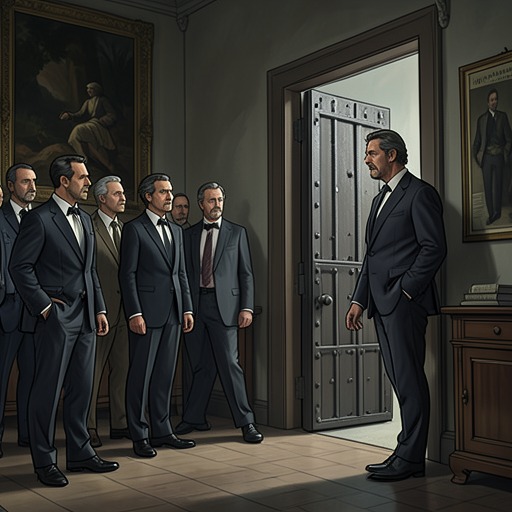
The reversal begins when copies of Oparna’s letter reach journalists and scientists around the world. The letter alleges that she falsified the research on Acharya’s instructions. Its circulation quickly becomes a media story about scientific fraud, while readers divide between suspicion of Acharya and the belief that Oparna’s accusation is revenge. The public narrative is already moving faster than a formal investigation, and the celebrated discovery is recast as a possible deception. The internal trial lasts one day. After Oparna leaves, postdoctoral researchers associated with the Balloon Mission do not pursue the case. The jury instead hears complaints from thirteen scientists who say Acharya mentally tortured them. Their grievances include his refusal to permit SETI research, his treatment of string theorists, and his humiliating manner; radio astronomers say they were barred from SETI seminars while resources were directed to the Balloon Mission. The shift from the sampler dispute to complaints about Acharya’s conduct gives Nambodri’s challenge a broader institutional basis, even as the evidence concerning the alleged fraud remains thin. By evening, word spreads that Acharya confessed, though the source of the story is unclear. At the Institute gates, Basu announces that Acharya admitted ordering Oparna to falsify research in order to claim the discovery of life at forty-one kilometres. Basu also accuses him of misusing Institute funds, humiliating colleagues, and using the basement for activities deemed inappropriate. Acharya is suspended until further notice, and Nambodri is elevated to acting Director. In the following days, Acharya denies confessing to sampler contamination, but his silence about his relationship with Oparna and the basement allegations leaves public perception free to join separate accusations into a single picture of misconduct. Nambodri’s accession is staged as a public and collegial triumph. As he and Basu walk to the Director’s office, scientists follow them; Basu ceremonially invites Nambodri to enter first, and the crowd applauds. In the large black leather chair, Nambodri jokes that there was no Big Bang, and the gathered scientists laugh. The joke turns Acharya’s known opposition to the Big Bang into a display of the new leadership’s command of the room. At the same time, Ayyan is secretly trying to piece together shreds of Acharya’s letter to Basu, preserving a trace that might later matter. The new administration’s apparent welcome therefore coexists with evidence that the settlement may not be final.
Recordings, Exposure, and Riot
The later circulation of recordings overturns the balance of the scandal. News channels begin airing the voices of men in the Institute discussing the intellectual limitations of Dalits and women. Female reporters and presenters criticize the people running Indian science, while Nambodri grows silent and the phones ring unanswered. The recording makes the controversy larger than Acharya’s possible misconduct: it exposes discriminatory judgments embedded in the institution that had investigated him and claimed authority to speak for science. The astronomers fear two consequences at once. A recording of Oparna’s conversation with Acharya may exonerate him and make his return possible; the newly broadcast remarks may provoke a backlash. Nambodri had previously suggested that the recording could be challenged, but the group recognizes Oparna’s voice. Outside, police vans stand at the gates, while peons have already gone on strike. Before gathering near the main lawn, they leave taps running and clog the toilets with broken cutlery. The institutional crisis now has visible, material consequences within the Institute, as its workers withdraw their labor and its ordinary facilities are disrupted. The violence escalates when stones break the windows and a mob enters the astronomers’ room, damaging its contents and beating the scientists. Three hours pass before order is restored. Police carry rioters away as cameras record them; a car burns in the driveway, other vehicles have broken windscreens, and windows hang damaged from the main building. The Institute’s occupants leave in a silent line under police escort. Protests elsewhere in the city are less violent, although an effigy named for Nambodri is beaten and burned outside Bombay Hospital. Stray violence is reported elsewhere in the country, and the riots recede after two days. The upheaval thus refuses a clean verdict. The Institute first celebrates a discovery as a shared triumph, then turns institutional complaints and an accusation into Acharya’s suspension and Nambodri’s ascent. Later recordings reveal that the inquiry’s political setting cannot be separated from caste and gender prejudice, while the threat of Acharya’s possible return and the outbreak of violence make the new order unstable. The pursuit of truth remains an ideal voiced by the scientists, but the scandal shows how evidence, reputation, resources, and authority can become entangled before that ideal is secured.